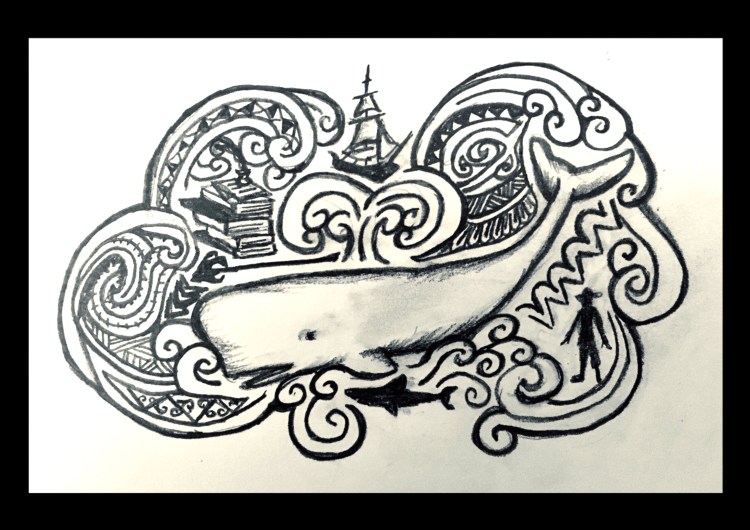
Reading Moby Dick for the first week of grad school seemed oddly fitting to my recent experiences at orientations bombarding me with new information, and new classes in which I was exposed to unfamiliar names, concepts and theories that the other students animatedly discussed in the face of my shrinking self-confidence. The monstrous book is what might be considered an encyclopedic novel, crammed full of disparate pieces of knowledge that no reader can possibly hope to absorb all at once. In a way the whole book is a testament to the futility of hoping to understand something in its entirety, as seen in Ishmael’s desperate attempts to depict the whale through literary references, cetology, philosophy and more but only highlighting the fact that the whale is an ever-elusive creature, always half-submerged in water and hidden from full examination.
This was my second time reading Moby Dick, and despite how much I passionately complained about the difficulty of getting through the book, there were many parts of the book that were fascinating to me. There is of course, Chapter 42, “The Whiteness of the Whale,” which contemplates why the albino whale in question is so terrifying in relation to its whiteness, a colour often associated with beauty and racial superiority but strikes all the more terror when coupled with danger. This I particularly enjoyed because I’ve always been drawn to ideas of the sublime and monstrosity (before I decided I was going to pursue something along the lines of Asian American and Asian diasporic literature, I nursed a fondness for the Gothic genre). I also liked discussing the homosexuality hinted at through the characters of Ishmael and Queequeg which had me shipping the couple until the very end, when they are together even in death as Ishmael floats as the only survivor on Queequeg’s pre-made coffin-turned-buoy, Titanic style (or less romantically, as someone pointed out, Ishmael the white man survives on the fruits of the native man’s labour, as the cannibal Queequeg had painstakingly carved out the coffin for himself earlier before he met his watery death). Because the novel is so abstract, the story can be seen as an allegory for just about anything, from slavery, colonialism, capitalism, human agency versus fate, and so the list goes on. The number of possible readings makes me somewhat uneasy, but the book was a good start in helping me accept my fate of perpetually feeling like I don’t quite know everything I should know—welcome to the life of a graduate student, or any human being—and at the same time feel excited about the endless possibilities of meaning-making because we aren’t bound to just the one interpretation.
All these readings of Moby Dick had been somewhat familiar to me before from my undergraduate studies, but something that really struck me was seeing the book through the lens of disability studies. I had never considered the book could be a narrative about disability, and of course this speaks for the the invisibility of disability in most cases, that it wasn’t even on my radar. There is of course Ahab, who lost his leg to Moby Dick and is now hunting him down for revenge, but looking for disability in the book, I could suddenly see it everywhere. Ahab’s mood swings and Ishmael’s depression are “abnormal” conditions, but disabilities can be found in the scars or blindness of poor injured whales, other lost limbs, inability to participate in social exchanges, age, and even skin colour when the white characters exploit others of colour. I’m not saying that race is a disability, exactly; but historically it is seen as a factor that limits individuals from physical and social mobility much like other supposed disabilities, and something that pushes these individuals to the outskirts of society. The same can be said when we reach old age (I always fear: when we are unable to keep up with the new generation of technology, are we disabled in some way?) and even other sexual orientations (reason why there are overlaps in crip and queer theory). Taking disabled as simply the opposite of able-bodied, whatever that term means as dictated by society, all of us at some point whether from temporary injury, age, etc. will be disabled. This made me see the concept of disability in a whole new light, and that I too had been brainwashed into regarding disability as something at the fringes of society instead of a powerful force that helps form through contrast and deliberate difference what the “norm” is. Because I’m interested in ethnic literature and issues of race, it was eye-opening to see that “the disabled” are a minority group because of structural oppression as well, not necessarily because of numbers or some lesser quality.
Do I have a neat or profound conclusion from all these thoughts? No. After all, focusing on the final product of any process is a very capitalist mode of thinking, something that aids in devaluing certain individuals if they cannot contribute productive labour, such as disabled populations. But in the spirit of Moby Dick, there doesn’t have to be a definite answer or comprehensibility anyway.
 Su Cool for School
Beautiful blog post, articulated very well! Looking forward to reading more about your graduate school journey.
LikeLiked by 1 person
I like that
LikeLiked by 1 person